 Add to Chrome
 Add to Firefox
 Add to Edge
AbstainGNN: Teaching Graph Neural Networks to Abstain for Graph Classification
May 29, 2026
Graph classification is a core task in graph data mining with widespread real-world applications. Recent advances in graph neural networks (GNNs) have led to substantial performance improvements for graph classification. However, existing GNNs are typically forced to make predictions even under high uncertainty or unknown conditions, resulting in unreliable decisions that can severely impact downstream tasks, particularly in safety-critical scenarios. To address this critical limitation, we propose AbstainGNN, a novel and theory-driven framework for graph classification with abstention, which enables GNNs to reject uncertain predictions instead of producing incorrect decisions. Specifically, AbstainGNN explicitly models both the predictive function and the abstention function, allowing for effective utilization of graph structural information. Moreover, unlike existing heuristic abstention methods, we theoretically characterize the trade-off between classification errors and rejection costs from a PAC-Bayesian generalization perspective, and derive a unified learning objective for model optimization. Guided by this theoretical insight, we further develop an efficient two-stage training strategy consisting of predictive function warm-start and abstention function calibration. Extensive experiments on five benchmark datasets show that AbstainGNN outperforms existing abstention methods, achieving superior classification performance under the same rejection rates.

FinHarness: An Inline Lifecycle Safety Harness for Finance LLM Agents
May 26, 2026Finance LLM agents must simultaneously block prompt-induced unauthorized actions and approve legitimate multi-step business workflows. However, boundary filters often miss irreversible mid-trajectory tool calls, while post-hoc LLM judges perform auditing only after termination -- too late for intervention and at a computational cost that scales linearly with trace length. We present FinHarness, an inline safety harness that wraps a finance agent end-to-end with three components: a Query Monitor that fuses single-turn intent with cross-turn drift, a Tool Monitor that evaluates each prospective tool call, and a Cascade module that integrates per-step risk and adaptively routes verification between a lightweight and an advanced-tier LLM judge. Fired risk factors are re-injected into the agent input as ex-ante evidence, enabling the agent to refuse, re-plan, or approve on its own. On FinVault, routed FinHarness cuts ASR from 38.3% to 15.0% while largely preserving benign approval ($41.1\% \to 39.3\%$), and uses $4.7\times$ fewer advanced-judge calls than an always-advanced ablation.
ExTax: Explainable Disinformation Detection via Persuasion, Emotion, and Narrative Role Taxonomies
May 26, 2026The democratization of LLMs has accelerated the generation and circulation of highly fluent disinformation, making traditional syntax-semantic verification increasingly insufficient. Such deception rarely relies solely on surface-level falsity; instead, it often combines persuasive rhetoric, emotional manipulation, and narrative role construction to influence readers' interpretations through multiple cognitive pathways. However, existing detectors typically emphasize isolated signals -- such as syntax, external knowledge, persuasion, or affective cues -- and therefore struggle to capture the multi-faceted manipulative intents underlying disinformation or provide human-auditable explanations. To address this gap, we present \textbf{ExTax}, a taxonomy-aligned framework for explainable disinformation detection. ExTax unifies persuasive rhetoric, emotional manipulation, and narrative roles into a 17-dimensional taxonomic space, covering 6 persuasive-rhetoric strategies, 5 emotional-manipulation methods, and 6 narrative-role categories. It elicits attributes from multiple frontier LLMs, reconciles their disagreements through Entropy-driven Dynamic Label Smoothing, and fuses the resulting taxonomic representations with contextual encodings via Heterogeneous Multi-Head Attention, grounding each prediction in an interpretable manipulation profile. Across five cross-domain and cross-genre benchmarks, ExTax achieves an overall Macro $F_1$ of $0.8456$, outperforming state-of-the-art deep learning and LLM-based baselines. It also remains robust under severe genre imbalance, where the strongest deep baseline degrades from $0.9454$ to $0.6194$.
SafeHarness: Lifecycle-Integrated Security Architecture for LLM-based Agent Deployment
Apr 15, 2026The performance of large language model (LLM) agents depends critically on the execution harness, the system layer that orchestrates tool use, context management, and state persistence. Yet this same architectural centrality makes the harness a high-value attack surface: a single compromise at the harness level can cascade through the entire execution pipeline. We observe that existing security approaches suffer from structural mismatch, leaving them blind to harness-internal state and unable to coordinate across the different phases of agent operation. In this paper, we introduce \safeharness{}, a security architecture in which four proposed defense layers are woven directly into the agent lifecycle to address above significant limitations: adversarial context filtering at input processing, tiered causal verification at decision making, privilege-separated tool control at action execution, and safe rollback with adaptive degradation at state update. The proposed cross-layer mechanisms tie these layers together, escalating verification rigor, triggering rollbacks, and tightening tool privileges whenever sustained anomalies are detected. We evaluate \safeharness{} on benchmark datasets across diverse harness configurations, comparing against four security baselines under five attack scenarios spanning six threat categories. Compared to the unprotected baseline, \safeharness{} achieves an average reduction of approximately 38\% in UBR and 42\% in ASR, substantially lowering both the unsafe behavior rate and the attack success rate while preserving core task utility.
Hard Constraints Meet Soft Generation: Guaranteed Feasibility for LLM-based Combinatorial Optimization
Feb 01, 2026Large language models (LLMs) have emerged as promising general-purpose solvers for combinatorial optimization (CO), yet they fundamentally lack mechanisms to guarantee solution feasibility which is critical for real-world deployment. In this work, we introduce FALCON, a framework that ensures 100\% feasibility through three key innovations: (i) \emph{grammar-constrained decoding} enforces syntactic validity, (ii) a \emph{feasibility repair layer} corrects semantic constraint violations, and (iii) \emph{adaptive Best-of-$N$ sampling} allocates inference compute efficiently. To train the underlying LLM, we introduce the Best-anchored Objective-guided Preference Optimization (BOPO) in LLM training, which weights preference pairs by their objective gap, providing dense supervision without human labels. Theoretically, we prove convergence for BOPO and provide bounds on repair-induced quality loss. Empirically, across seven NP-hard CO problems, FALCON achieves perfect feasibility while matching or exceeding the solution quality of state-of-the-art neural and LLM-based solvers.
Wide & Deep Learning for Node Classification
May 04, 2025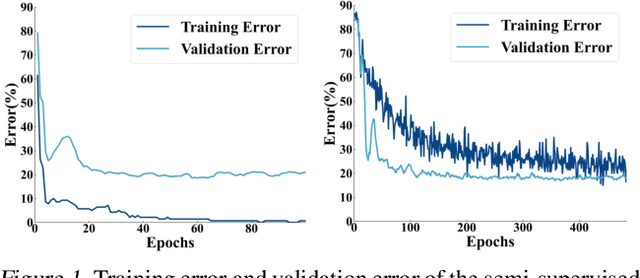
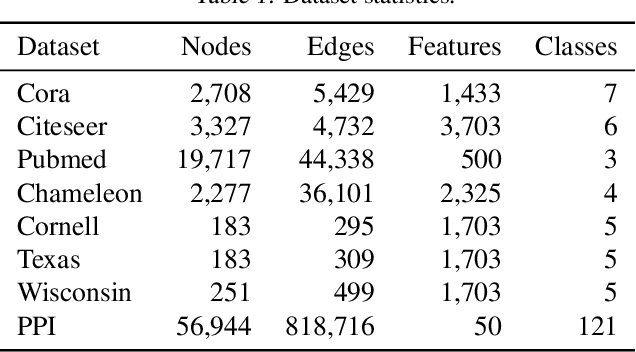
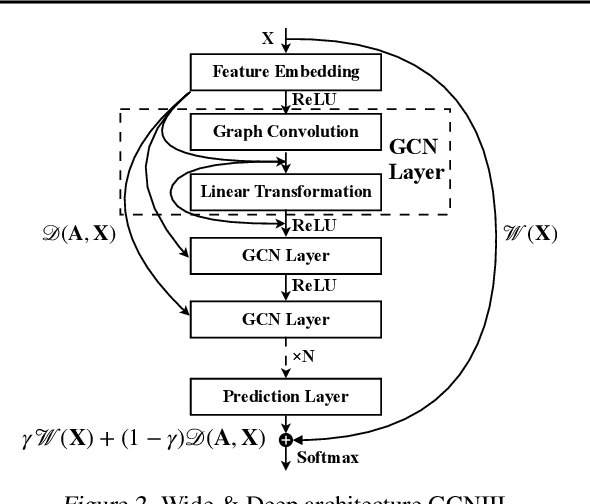
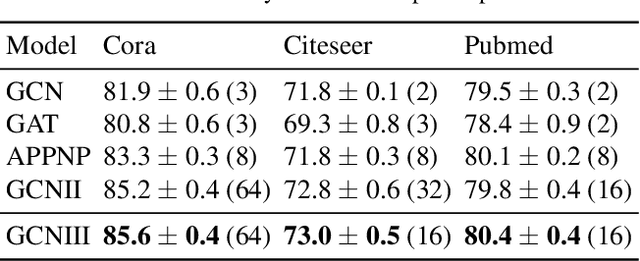
Wide & Deep, a simple yet effective learning architecture for recommendation systems developed by Google, has had a significant impact in both academia and industry due to its combination of the memorization ability of generalized linear models and the generalization ability of deep models. Graph convolutional networks (GCNs) remain dominant in node classification tasks; however, recent studies have highlighted issues such as heterophily and expressiveness, which focus on graph structure while seemingly neglecting the potential role of node features. In this paper, we propose a flexible framework GCNIII, which leverages the Wide & Deep architecture and incorporates three techniques: Intersect memory, Initial residual and Identity mapping. We provide comprehensive empirical evidence showing that GCNIII can more effectively balance the trade-off between over-fitting and over-generalization on various semi- and full- supervised tasks. Additionally, we explore the use of large language models (LLMs) for node feature engineering to enhance the performance of GCNIII in cross-domain node classification tasks. Our implementation is available at https://github.com/CYCUCAS/GCNIII.